
Games
Stock Market Game: How to Pick One That Actually Teaches You
Fees, news and other players are what turn a trading game into practice. What to look for, how one shared-market game works, and where paper trading still wins.

A stock market game is worth your time when mistakes cost something: a fee on every trade, news that moves prices without warning, and other people trading the same market. Many free games skip all three. This guide covers what to look for, how WallThrone handles each point, and how it compares with broker paper trading and the classroom simulators many American students meet first.
In short
- A good stock market game charges fees, reacts to news and lets losses stick.
- Broker paper trading is the closest rehearsal for a real US brokerage account.
- Classroom simulators teach the basics well, then stop when the semester ends.
- No game predicts what you would earn with real money.
What makes a stock market game worth playing?
Fun is the easy part. The real question is whether the habits you build would survive a real brokerage account. Four things decide it.
- Costs on every trade. Real trading always costs something, even at zero-commission brokers, because the gap between the bid and the ask is still there. A game that lets you flip in and out for free trains you to overtrade.
- Prices that react to something. If charts move at random, you learn to gamble. If they move on news and on what other players do, you learn cause and effect.
- Losses that stick. A reset button after every blow-up teaches nothing about risk. A loss that sets you back, and takes time to recover, does.
- A reason to be patient. Good decisions often come from waiting. A game should reward the player who sits on cash when nothing looks right.
Short contests deserve a warning. When a leaderboard closes after a few weeks and only first place counts, the winning move is to bet everything on one stock and hope. That wins contests. It does not build investors.
How WallThrone works as a stock market game
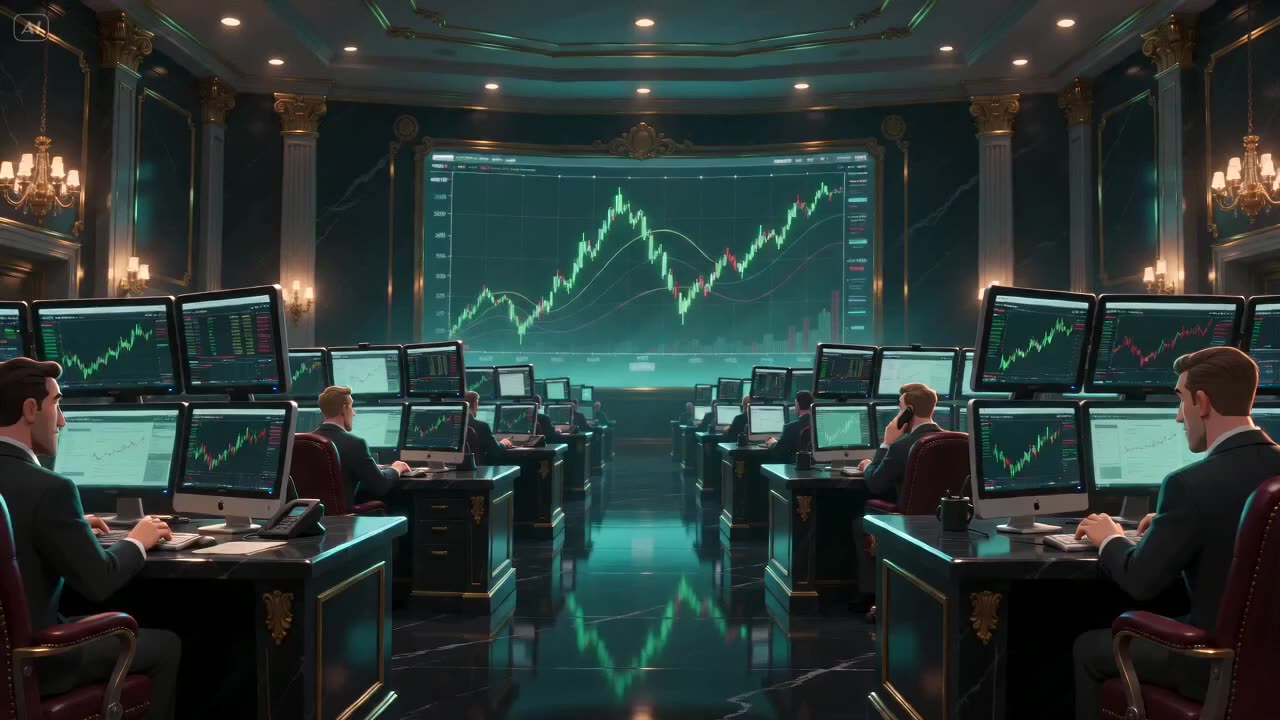
It is a free game played in the browser, on desktop and mobile, built around one exchange: the WSX. Every player trades the same fictional companies, with tickers like ORDY, QNTS and PXFG, at the same prices at the same moment. Prices come from the game’s own model, not from real quotes, and they move every five seconds.
One shared market that never closes
There is no closing bell and no pause button. Stories on Ticker TV move prices, sometimes without warning, and when big players buy, the price rises for everyone. You are not trading against a static chart. You are trading in a crowd.
A story with a score to settle
You start with $25,000 of play money, a Startup Office and two employees, as Adrián Vale, the deal maker, or Valeria Noir, the strategist. Your former partner, Victor Morrow, kept your share of the firm and left you a check to disappear. Forty-three missions across five acts take you back toward him. Each act puts a boss above you in the ranking, from Dax Holloway of Silver Fox Desk to the Kings and, finally, Morrow. Your decisions lead to one of three endings.
A team that trades while you are away
Traders you hire take a slice of your capital and trade it for up to 12 hours while you are offline, for an hourly salary. Analysts and compliance staff fill the other seats. It is a quiet lesson in delegation: a good trader with too much of your money can still hurt you.
A regulator that keeps score
The Commission, the game’s market regulator, watches what you do. Illegal shortcuts, such as acting on a tip from The Insider, raise your Heat on a scale of 0 to 100: a letter at 30, an inspector at 50, a raid at 70, a trial at 90. In prison you cannot trade, and the market does not wait.
Test your rules where mistakes are cheap. Start with $25,000 of play money on the WSX, set a limit per trade and see whether you keep it when Ticker TV breaks a story.
Start playingStock market game, paper trading or classroom simulator?
Each tool rehearses something different, and none is right for everyone.
| Option | Prices | Best for | Main limit |
|---|---|---|---|
| Broker paper trading | Real NYSE and Nasdaq quotes, sometimes delayed | Learning a broker’s order screens before you fund an account | Your orders never move the market, and resets are easy |
| Classroom simulator | Real US stocks and funds | The basics, with a teacher, a team and a deadline | Runs on the school calendar, then stops |
| Shared-market game such as WallThrone | Fictional companies, priced by the game every five seconds | Habits under pressure: news, fees, rivals, rules | No real companies to research; play money only |
| A small real account | Real | The emotions no simulation copies | Every mistake costs real money |
Paper trading at a US broker is the most faithful rehearsal of the mechanics: the same order ticket, the same symbols, the same market hours. If you already know which broker you will use, its practice account is worth an afternoon. The SIFMA Foundation’s classroom program, The Stock Market Game, is the version many students meet in school, and its strength is structure: teams, a teacher and a fixed session.
A game earns its place through pressure. In a shared market, someone else’s buying moves your price, and a headline can turn a good position bad within minutes. That is closer to the feel of a real trading day than a quiet spreadsheet, even with invented companies. For the trade-offs in more depth, read what paper trading teaches and what it misses.
What no stock market game can teach you
Know the limits before you read too much into a good run.
- Real fear. Losing play money stings. Losing money you need for rent is a different feeling, and it changes decisions.
- Company research. Fictional companies publish no annual reports. Real US companies file theirs with the SEC, and anyone can read them free on EDGAR. Reading a 10-K is its own skill.
- Taxes and account types. How gains are taxed, and how an IRA differs from a regular brokerage account, sit outside any game. Start with official sources or a qualified professional.
Research on real accounts points in the same direction as a fee-charging game. In a well-known study of US household brokerage accounts, Brad Barber and Terrance Odean found that the households that traded most earned clearly less, after costs, than the market. A game lets you feel that drag early, for free.
How to get real lessons out of a stock market game
Play with rules, or the game will only teach you what luck feels like.
- Set a position limit before your first trade. For example, no more than 10% of your account in one company: $2,500 on a $25,000 start.
- Write one line before every trade: why you are buying, and what would prove you wrong.
- Count your costs. At 0.05%, a $10,000 purchase costs $5 in commission and selling it costs about $5 more. Twenty round trips of that size in a day come to roughly $200, or 0.8% of a $25,000 account, before a single trade goes wrong.
- Treat news as an experiment. When Ticker TV runs a story, note the price, then check it again five and thirty minutes later.
- Review once a week. Find your largest loss and ask whether it broke one of your own rules.
- Keep losses on the record. Starting over to erase a mistake throws away the lesson.
Most of the errors you log will have names. Reading about the biases that cost investors most before you start makes them easier to spot.
Before you move to real money in the US
A game can show whether you follow your own rules. It cannot tell you that you are ready to invest. If you decide to open an account:
- Check the firm and any adviser on FINRA BrokerCheck.
- Read Investor.gov, the SEC’s site for individual investors, on fees, diversification and fraud.
- Know what SIPC coverage does: it protects customers when a member brokerage fails, not when prices fall.
- Start with an amount you could lose without changing your life.
Rules change, so trust official sources over any blog, this one included.
Frequently asked questions
Is there a free stock market game that uses real stocks?
Yes. Most broker paper trading accounts and classroom simulators use real US-listed stocks with live or delayed prices. A shared-market game takes another route: fictional companies on their own exchange, priced by the game’s model. You cannot look up what happens next anywhere else, and every player sees the same prices at the same moment.
Can you win real money in a stock market game?
Not in WallThrone. Everything you trade is play money, and results stay in the game. Optional credit packs exist, but credits are an in-game currency for hiring, moving headquarters and similar, not an investment. Be wary of any game or app that promises real returns: that pitch is a common opening for investment fraud.
Do I need to download an app to play?
No. The game runs in the browser on desktop and mobile, so there is nothing to install. Guests start with an email address and no password. The market keeps moving after you close the tab, which is why hired traders, able to work up to 12 hours on their own, earn their salary.
How long should I play before investing for real?
There is no official threshold. A sensible test is consistency: a few months and several dozen logged trades in which you kept your own position limits, losing streaks included. If your rules break every time the market turns, practice longer. Doing well in a game is not the same as being ready for a real portfolio, so read the SEC’s investor guidance first.
WallThrone is a game with play money and fictional companies, not a broker, and it offers no access to real markets. This article is for education only and is not financial advice.