
Games
Business Tycoon Games: Why They Hook Us and What They Teach
Theme parks, railways, trading houses: tycoon games share one loop. What it teaches about money, what it quietly leaves out, and why a market shared with other players changes the lesson.

Business tycoon games put you in charge of a park, a railway, a factory or a trading house and let you grow it from almost nothing into an empire. They hook us because progress is visible and every good decision compounds. The best of them teach real ideas about cash flow and reinvestment. Few teach what happens when other people's decisions move the same market as yours.
In short
- The loop is simple: earn, reinvest, grow, unlock. Visible progress and compounding make it hard to stop.
- Good tycoon games teach cash flow, fixed costs, opportunity cost and the danger of growing too fast.
- Most leave out rivals who move your prices, rules with consequences and the sting of a loss you cannot reload.
- A shared live market, a regulator and moral choices bring the genre closer to how finance behaves.
What are business tycoon games?
A tycoon game is a management simulation with an ambition: not just running a business, but building an empire. The genre has a long line. Railroad Tycoon and Transport Tycoon turned networks of trains and trucks into puzzles of routes and revenue. Theme Hospital and RollerCoaster Tycoon made queues, prices and staff into a balancing act. Capitalism added competitors, brands and a stock market. Today there are idle tycoons on phones, where numbers climb while you sleep, and browser games built around trading floors.
The board-game ancestors are older still. Many Czech families learned the logic on Dostihy a sázky, the horse-racing cousin of Monopoly. The pleasure is the same in every version: you start small, the map fills up, and every decision leaves a visible mark.
Why tycoon games are so compelling
- Visible growth. The map fills, the balance rises, the office gets bigger. Few things in adult life show progress this clearly.
- Compounding. Profits fund the next ride, route or hire, which funds the next. It is the arithmetic of compound interest, and it feels just as good.
- Endless optimisation. There is always one queue to shorten, one price to tune, one cost to cut.
- Rules you can learn. Unlike real markets, most tycoon worlds reward study with near certainty.
- Flow. The psychologist Mihaly Csikszentmihalyi described flow as the state where challenge and skill rise together. Good tycoon games tune their difficulty to keep you right there.
Notice the fourth point. It is the main reason the genre feels so satisfying, and the main reason it can mislead.
What business tycoon games actually teach about money
Played with attention, a good tycoon game is a decent short course in business basics.
| Lesson | How the game shows it | The real-world version |
|---|---|---|
| Cash flow beats paper profit | A profitable park that runs out of cash still stalls | Companies fail for lack of liquidity, not only for lack of profit |
| Fixed costs never sleep | Wages and maintenance drain money every hour | Rent, salaries and platform fees, in good months and bad |
| Reinvestment compounds | Profits fund new routes, rides or desks | Retained earnings and reinvested returns |
| Opportunity cost | Money in one building cannot be in another | Every investment is a choice against all the others |
| Growing too fast | Expansion on borrowed money that the next slump punishes | Leverage and overtrading |
These lessons are real. They are also mostly about running a business, not about markets.
What most tycoon games leave out
- Other people. In most single-player games, prices answer to a formula, not to rivals. Nobody else's decision moves your numbers.
- Uncertainty. Predictable models reward memorised strategies. Real markets reward humility.
- Rules with teeth. Few games have a regulator, so shortcuts cost nothing.
- Loss that hurts. Daniel Kahneman and Amos Tversky showed that a loss weighs more than a gain of the same size. A reload button erases that lesson.
- Limits. Idle games grow forever. Real businesses meet saturated markets, competitors and bad years.
Czechs have their own real-life case study. In the early 1990s, voucher privatisation turned millions of citizens into shareholders almost overnight, and investment funds competed for their voucher points with bold promises. Some of those promises did not survive, and the word tunelování (tunnelling, the stripping of a company's assets) entered everyday Czech. It was a lesson in incentives, governance and supervision that no single-player game reproduces. Today the Czech National Bank supervises the capital market, including the Prague Stock Exchange.
How WallThrone differs from a classic tycoon game
The tycoon bones are familiar: you start with 25,000 play dollars, a tiny Startup Office and two employees, climb ranks by net worth from Nobody to King, and move into bigger headquarters as you go. Four things change the lesson.
A live market you share
There is one exchange, the WSX, the same for every player at the same time. Prices move every five seconds, news on Ticker TV moves them, sometimes without warning, and what big players buy moves the price for everyone. The world never closes. Your decisions sit inside other people's.
A story with stakes
Your former partner, Victor Morrow, betrayed you, kept your share and left you a cheque to disappear. You come back for his throne across 43 missions in five acts, passing bosses such as Dax Holloway of Silver Fox Desk, Conrad Blackwell of Black Marble Capital and Cassian Reed of Gilded Lion Partners in the ranking, then the Kings, then Morrow himself. Your decisions lead to one of three endings.
A regulator that watches
The Commission tracks illegal moves through your Heat, from 0 to 100: a letter at 30, an inspector at 50, a raid at 70, a trial and possibly prison at 90. The Insider knows what is going to happen, and using him is exactly the kind of move that raises Heat. In prison you cannot trade, and the market keeps moving without you.
Choices with moral weight
Calls and messages offer decisions that shift your karma between Light, Balance and Dark, and change your influence, fear and trust. Success is not only a number.
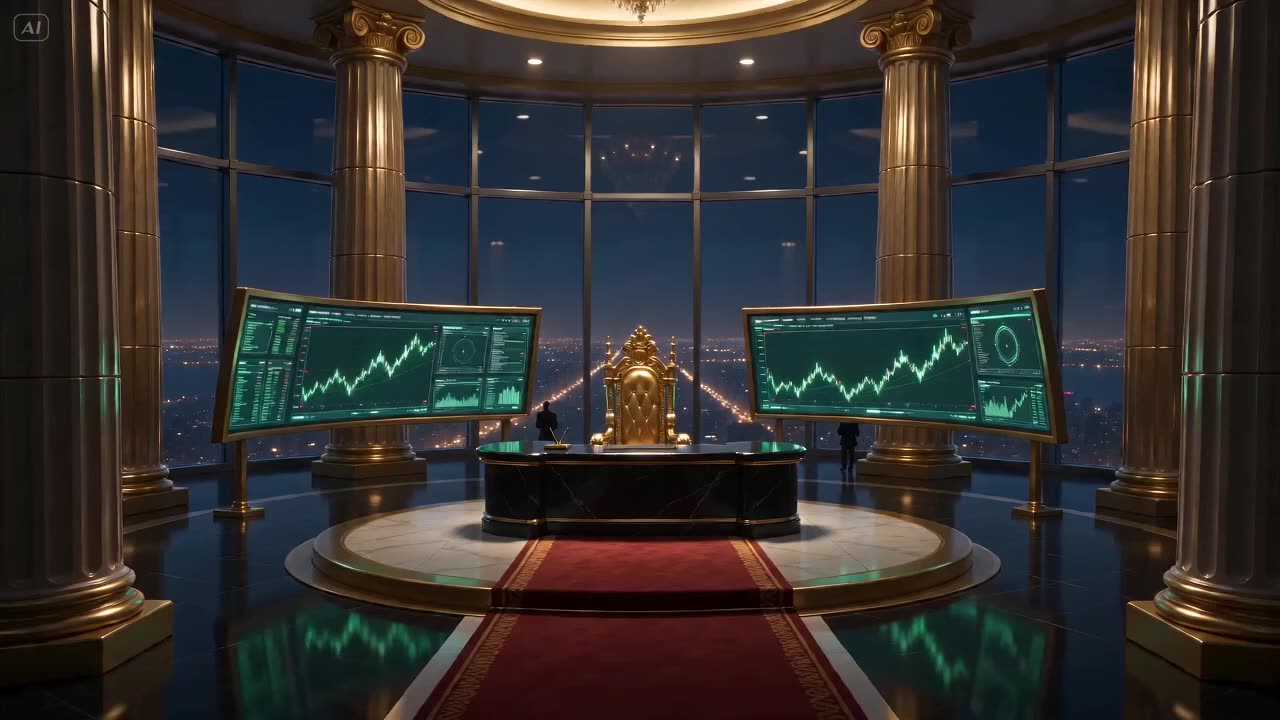
Build the empire where others move the price too. Start with 25,000 play dollars and a Startup Office, trade the WSX alongside other players and see how a regulator and a revenge story change the way you play.
Start your empireWhat you really learn, and what you do not
Be honest about what transfers. A market game can train habits: placing orders, sizing positions, reading the news before reacting, counting costs (every trade pays a 0.05% commission) and sitting still when nothing is clear. Hiring traders who keep trading while you are away, at an hourly salary, shows that delegating capital is a cost and a risk, not free income. Candle Call, where you bet 1, 5 or 10% of your cash on the colour of the next one-minute candle, shows quickly what position size does to a bad streak.
It cannot teach you to value a real company, because the companies are fictional and prices come from the game's own model. It cannot teach tax rules or the weight of real money, and results in the game do not predict results with real money. For real prices without real risk, a broker's demo account is a fair complement. For a wider view, read what a stock market game can and cannot teach and which games teach investing best.
How to get real lessons from any tycoon game
- Keep a simple ledger beside the game: cash in, cash out, fixed costs per hour or month.
- Before each big purchase, write one line on what else that money could do.
- After each session, note one mistake and the rule it suggests.
- Play at least once without reloading after a loss, and notice how differently you decide.
- Test any idea that seems to work against an official source, such as the consumer information published by the Czech National Bank.
Frequently asked questions
What are the best business tycoon games?
It depends on what you want to practise. Classic simulations such as Transport Tycoon or RollerCoaster Tycoon are strong on operations and cash flow. Capitalism adds competitors and a stock market. Idle tycoons are relaxing but teach little. If markets interest you most, look for games where prices respond to other players and every trade has a cost.
Are there free tycoon games you can play in a browser?
Yes, plenty, from simple idle games to deeper strategy titles. WallThrone is one built around a trading house: free to play in the browser on desktop and mobile, with optional credit packs. Before you start any free game, check what it charges for and whether progress depends on paying or on playing well.
Can tycoon games teach you how to invest?
They teach useful concepts: cash flow, compounding, opportunity cost and the danger of expanding on borrowed money. They do not teach real investing skill, because nothing real is at risk and most game worlds are predictable. Treat them as a warm-up. In the Czech Republic, the Czech National Bank publishes consumer information on financial markets and lists authorised firms.
What is the difference between a stock market tycoon game and a trading simulator?
A trading simulator, or a broker's demo account, copies real prices and real order types with virtual money; its goal is realism. A stock market tycoon game wraps trading in progression, story and goals, often with fictional companies. The simulator teaches the platform; the game keeps you practising long enough to build habits. Many learners use both.
WallThrone uses play money and fictional companies: it is a game, not a broker, and gives no access to real markets. Nothing here is financial advice.